
brimble.toml is a file in your repository that describes how your project runs: build and start commands, compute, scaling, volumes, environment variables, networking, domains, alerts, databases, buckets, and environments. When you push, Brimble compares the file with what’s running and applies the difference.
Safe changes apply on their own. New resources and risky changes wait for you to approve them in the dashboard, and changes that can’t be made safely stop the deploy with a clear reason.
Quickstart
- In the dashboard, open your project, go to Configuration → Config as code, and click Generate brimble.toml. Brimble writes a file from your project’s current settings. Environment variable values are left out, so nothing secret ends up in your repository.
- Download it, commit it at the root of your repository (or inside your project’s root directory), and push.
- The next deploy reads the file. Because it matches what’s already running, nothing changes.
- Edit the file and push again. Your changes apply as part of that deploy.
Where Brimble looks for the file
On each push, Brimble readsbrimble.toml at the pushed commit, in this order:
- Your project’s root directory (set under Configuration → General), for example
apps/api/brimble.toml. - The repository root.
What happens when you push
Each change in the file falls into one of four groups.
Resources that exist in the dashboard but aren’t in the file are never deleted. The review screen lists them under Not in brimble.toml so you can see them.
Approving changes
When a deploy needs approval, its status in Deployment history is Needs approval with a Review config as code link. The review screen lives at Configuration → Config as code and shows:- Each resource grouped by what will happen (blocked, creates, needs approval, applies automatically), with a field-by-field before and after.
- The file and commit the plan came from.
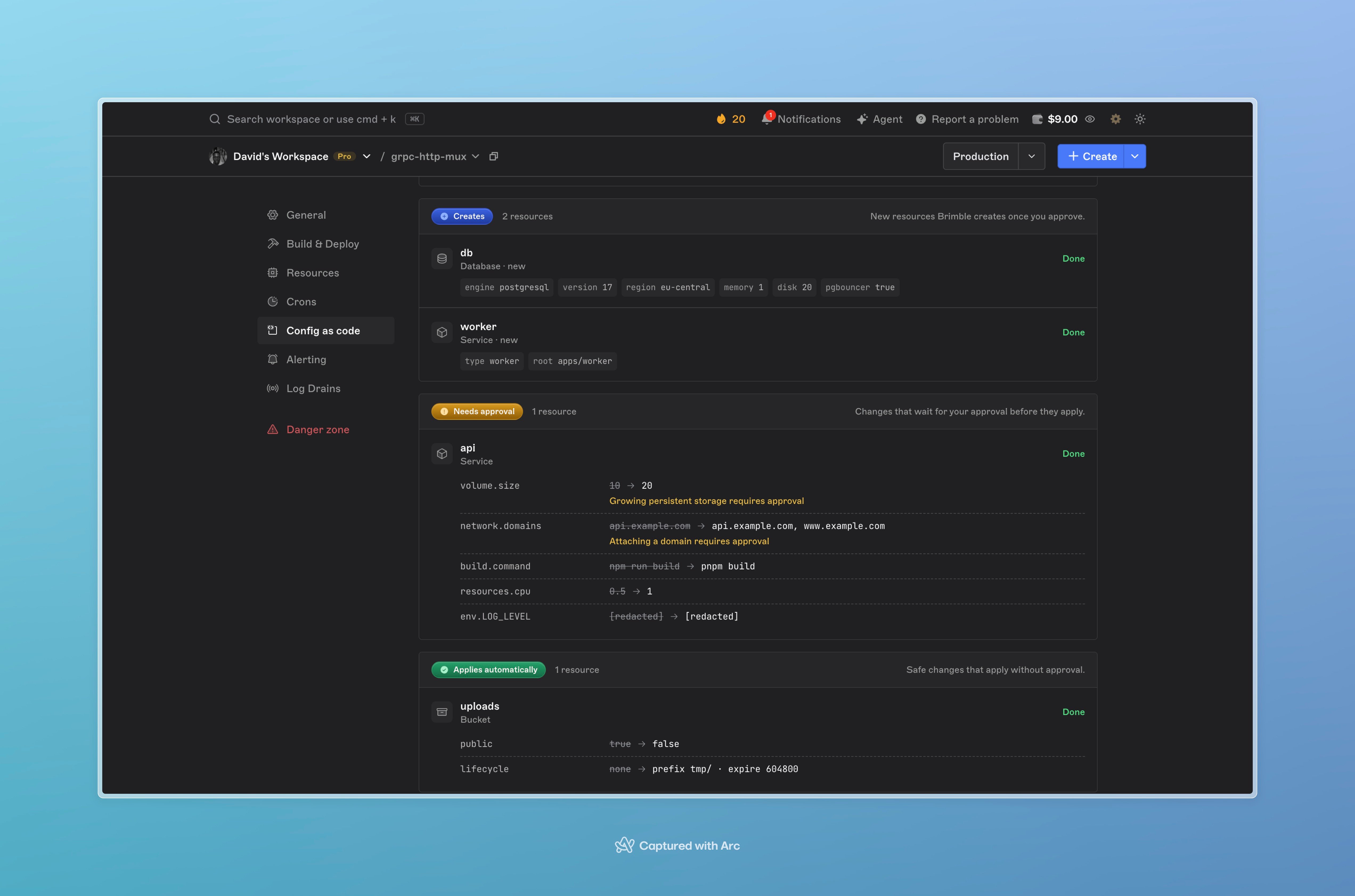
A plan under Configuration → Config as code, grouped by what happens to each resource.
When the file is invalid
A file with a TOML syntax error, an unknown field, or a value out of range fails the deploy. The deploy log lists each problem with its line number, for example:Settings managed by the file
Once a field is set inbrimble.toml, the dashboard shows it as read-only with a Managed by config as code badge, so a dashboard edit can’t silently drift from the file. To change the value, edit the file and push. Fields you don’t set in the file stay editable in the dashboard.
Environment variables and secrets
Values under[services.<name>.env] are written to your project’s environment variables on each push. They’re stored in your repository, so never put secret values in the file.
For secrets, set the value in the dashboard and list the name under secrets.required. The deploy is blocked until every required secret exists:
Connecting databases and buckets
Use the same references you use in the dashboard. Referencing a database or bucket that’s defined in the file also links it to the service:Multiple services in one repository
A file can describe several services. The key afterservices. is the project name:
- If the file has one service, it applies to the project it’s deployed from, even if the key doesn’t match the project name.
- If it has several, each service’s settings apply when that service deploys. A service in the file that doesn’t exist yet is created from the same repository, after you approve it.
Environments
Use[environments.<name>] to override settings for a workspace environment such as staging. Overrides are merged on top of the top-level settings when a project in that environment deploys:
inherit_from must lead back to production.
Pull request previews
[environments.preview] applies to every pull request preview of your services. It accepts build, deploy, and env only:
- Preview deploys never create resources or change your production settings.
envvalues here are preview-only. They override production values for previews and don’t touch production.
Generate or preview a file from the dashboard
Configuration → Config as code has two actions:- Generate brimble.toml writes a file from your project’s current settings, with syntax highlighting, copy, and download. Environment variable values are never included. Committing it unchanged produces no changes on the next push.
- Preview a file lets you paste a
brimble.tomland see what it would change before you commit it. The file is checked as you type, and Create plan stays disabled until it’s valid. Nothing changes until you approve the plan.
What the file can’t do
Some actions stay in the dashboard on purpose: deleting resources, restoring backups, running a backup now, rotating database passwords, managing database users, buying domains, dedicated outbound IPs, password protection, turning TLS or PgBouncer off, and converting a database to or from high availability.Troubleshooting
Deploy fails with “brimble.toml is invalid”. The log lists each problem with the field path and line. The most common causes are sizes without a unit (writememory = "1gb", not memory = 1) and durations without a unit (write "5m", not 300).
Deploy fails with “Required secret X is not set”. Add the variable under Environment in the dashboard, then redeploy.
Deploy fails with “This feature is not available on the current plan”. The file uses a feature your plan doesn’t include, for example autoscaling or custom domains. Remove it from the file or upgrade your plan.
A field is read-only in the dashboard. It’s set in brimble.toml. Change it in the file and push, or remove it from the file to manage it in the dashboard again.
A dashboard-only resource shows under “Not in brimble.toml”. That’s expected. Brimble never deletes resources that aren’t in the file.
Next steps
- brimble.toml reference, every field and its format.
- Environment variables and references.
- Environments.